GENISOM AIChina2026
Tongchui M1
- In production
- Over 40 kg
- Inspection
- Security and surveillance
- Defence and emergency response
- Logistics
Key figures as stated by the manufacturer
5 of 6 stated · 1 gap- Weight 41kg90.4lbOur conversion from 41 kg. The manufacturer does not state an imperial figure itself, so the conversion has no source of its own.A
- Payload, walking 30kg66.1lbOur conversion from 30 kg. The manufacturer does not state an imperial figure itself, so the conversion has no source of its own.A
- Runtime 210–300minWarning: load condition not statedA
- Max speed 21.6km/h13.4mphOur conversion from 21.6 km/h. The manufacturer does not state an imperial figure itself, so the conversion has no source of its own.A
- IP rating IP67A
- Indicative price not stated
Deviations and variants in the key figures (4)
Weight
CaveatIn the structured spec table - no 'approx.' mark. CONTRADICTED by the page's own marketing card: approx. 30kg own weight (the lightest in its class), approx. 30kg sustained working load, achieving a near-1:1 load-to-weight ratio, industry-first for quadrupeds. The two figures (41kg vs. 30kg) are the SAME robot's own weight on the SAME page and are in conflict. Rule 9: not silently corrected. The structured table is used as the field value because it is the more specific source (same principle as the rest of the GENISOM entries), but the inconsistency is not explained away.
Payload, walking
CaveatMaximum load. The marketing card uses the same 30kg figure to claim a 1:1 load-to-weight ratio based on a 30kg-own-weight claim, which contradicts the structured table’s 41kg — see the caveat on weight.
Runtime
Caveat5h unloaded / 3.5h full load. Qualitative load condition (unloaded/full), no kg figure tied directly to this row — hence the load condition is stated as not disclosed, even though a separate maximum-load figure of 30kg sits elsewhere on the page. A range is also disclosed; the schema has no range field.
Max speed
NoteA separate limit speed of 8 m/s is also disclosed — not used as the main value, same principle as L1/L2/L1-W.
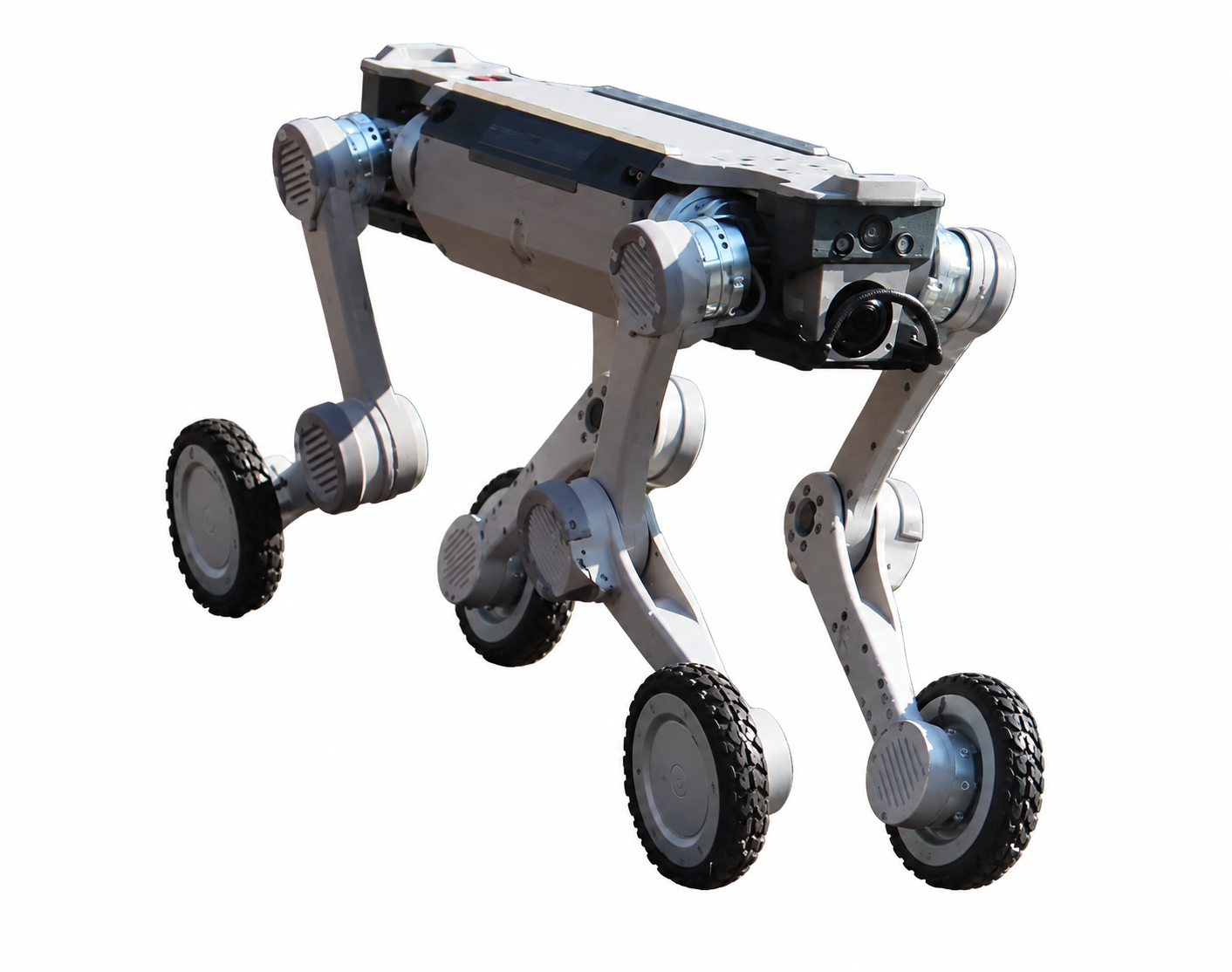
Manufacturer's own photo.
Own product page (genisomai.com/product-robot/M1). Photo replaced 14 September 2026 with a separate image from the manufacturer's own page — no longer shared with the M1 Pro/M1 Ultra, which keep their old shared photo (see genisom-tongchui-m1-pro and genisom-tongchui-m1-ultra).
Intended use, per the manufacturer
The manufacturer’s words
Forest firefighting
Petrochemical firefighting
Power-grid inspection
Site patrol
Logistics transport
Source: genisomai.com · Retrieved
From the section headed "next application scenario, already in place" on M1’s own product page. Own translation: forest firefighting -> defense and emergency response; petrochemical firefighting -> defense and emergency response (same category, two quotes); power-grid inspection -> inspection; site patrol -> security and surveillance; logistics transport -> logistics.
This category is not our assessment.
Every field in the schema
22 of 33 fields statedImperial figures are our own conversion unless the manufacturer states an imperial figure itself. The source letter always belongs to the metric figure — a conversion has no source of its own.
| Field | Value | Source and caveats |
|---|---|---|
| Physical | ||
| Weight | 41kg90.4lbOur conversion from 41 kg. The manufacturer does not state an imperial figure itself, so the conversion has no source of its own. | A CaveatIn the structured spec table - no 'approx.' mark. CONTRADICTED by the page's own marketing card: approx. 30kg own weight (the lightest in its class), approx. 30kg sustained working load, achieving a near-1:1 load-to-weight ratio, industry-first for quadrupeds. The two figures (41kg vs. 30kg) are the SAME robot's own weight on the SAME page and are in conflict. Rule 9: not silently corrected. The structured table is used as the field value because it is the more specific source (same principle as the rest of the GENISOM entries), but the inconsistency is not explained away. |
| Length | 93cm36.6inOur conversion from 93 cm. The manufacturer does not state an imperial figure itself, so the conversion has no source of its own. | A NoteNO 'approx.' mark on this row, unlike L1/L2's corresponding measurements. No operator set, per rule 4 (never invent a caveat the manufacturer did not write). |
| Width | 48cm18.9inOur conversion from 48 cm. The manufacturer does not state an imperial figure itself, so the conversion has no source of its own. | A |
| Height | 58.5cm23inOur conversion from 58.5 cm. The manufacturer does not state an imperial figure itself, so the conversion has no source of its own. | A NoteThe prone (lying-down) measurement is 930×630×200mm; the schema has no field for that state. |
| Degrees of freedom | 12DoF | A CaveatNumber of joint motors, in the structured table. See the top note on the meta description’s conflicting claim of 16 degrees of freedom, which is NOT used here. |
| Payload, walking | 30kg66.1lbOur conversion from 30 kg. The manufacturer does not state an imperial figure itself, so the conversion has no source of its own. | A CaveatMaximum load. The marketing card uses the same 30kg figure to claim a 1:1 load-to-weight ratio based on a 30kg-own-weight claim, which contradicts the structured table’s 41kg — see the caveat on weight. |
| Payload, standing | not stated | |
| Max speed | 21.6km/h13.4mphOur conversion from 21.6 km/h. The manufacturer does not state an imperial figure itself, so the conversion has no source of its own. | A NoteA separate limit speed of 8 m/s is also disclosed — not used as the main value, same principle as L1/L2/L1-W. |
| Max slope | 45° | A NoteMaximum climbable slope angle, confirmed by the marketing card’s "45° limit slope angle" — no separate standard/limit split here, unlike L1/L1-W. |
| Single obstacle | 80cm31.5inOur conversion from 80 cm. The manufacturer does not state an imperial figure itself, so the conversion has no source of its own. | A Note80cm vertical obstacle-crossing height, from the page’s marketing card — kept separate from stair_step_continuous, which carries a different, lower figure in the structured spec table. Same two-field pattern as L2/L1-W. |
| Stair step, continuous | 25cm9.84inOur conversion from 25 cm. The manufacturer does not state an imperial figure itself, so the conversion has no source of its own. | A NoteLabel: continuous stair-climbing height, in the structured spec table, confirmed by the marketing card. |
| IP rating | IP67 | A |
| Operating temperature, low | -20°C-4°FOur conversion from -20 °C. The manufacturer does not state an imperial figure itself, so the conversion has no source of its own. | A NoteThe base specification (-20 to 55°C) is used; the wider -40 to 80°C is only an optional battery version, not standard. |
| Operating temperature, high | 55°C131°FOur conversion from 55 °C. The manufacturer does not state an imperial figure itself, so the conversion has no source of its own. | A NoteSame caveat as temperature_min: -40 to 80°C is an optional wide-temperature battery version, not the base configuration. |
| Power | ||
| Battery | not stated | A NoteThe accessories list discloses: 54V, 2× 9.35Ah, dual battery, hot-swap. Wh is NOT printed directly, and we do not calculate Wh from Ah × V (rule 9). |
| Runtime | 210–300minWarning: load condition not stated | A Caveat5h unloaded / 3.5h full load. Qualitative load condition (unloaded/full), no kg figure tied directly to this row — hence the load condition is stated as not disclosed, even though a separate maximum-load figure of 30kg sits elsewhere on the page. A range is also disclosed; the schema has no range field. |
| Hot-swap battery | yes | A NoteConfirmed in two places on the same page: the marketing card (dual battery, hot-swap) and the accessories list (battery: 54V, 9.35Ah × 2; dual battery, hot-swap). |
| Charge time | less than 120min | A NoteCharging time. |
| Docking station | yes | A NoteAccessories list: charging dock, standard equipment. The marketing text separately mentions an optional smart charging station supporting autonomous return-to-charge on low battery — optional only, not standard. Same two-tier pattern as L1/L2’s docking_station. |
| Sensing and autonomy | ||
| LiDAR | 3D LiDAR (type and model not disclosed) | A NoteIn the structured sensor section — confirms presence, but neither line count, model nor manufacturer is disclosed (unlike L2-W Ultra, which names its LiDAR). |
| Cameras | 2× wide-angle camera, 8 MP each, DFOV 122° / HFOV 111° / VFOV 70° | A NoteThe sensor section also mentions a depth camera and an RTK positioning module without further specification — the schema has no dedicated field for either. |
| Onboard compute | 8-core CPU, 100 TOPS | A NoteBase compute: 8-core high-performance CPU, 100 TOPS. |
| ROS 2 | not stated | |
| SDK languages | not stated | B NoteINVESTIGATED, BUT NOT SET. GENISOM AI's GitHub organisation (zsibot) has a repo 'genisom_robot_sdk' (README: Programming Language: C++, Ubuntu 22.04/CMake/GCC/Boost), but the repo has NO GitHub description tying it to a specific product name (unlike 'genisom_L1_sdk', whose description explicitly names the Genisom AI L1 Series). Neither 'M1' nor 'Tongchui' appears in the extracted README text. Using the repo for M1 would be the same kind of name-coincidence-without-evidence that was caught and rejected on L2's ros2 field in the previous round - hence stated as not disclosed rather than a guess. |
| Autonomy level | AI reinforcement-learning motion control (standard); basic motions (march/glide/crawl positions, etc.; straight-line movement forward/back/left/right; rotation in place; knee-joint posture change; supports gravel/asphalt/grass/sand/forest floor/building-rubble terrain, etc.); special motions (climb high wall/cross obstacle plate/pass through narrow wall/wiggle, etc.); real-time image transmission; OTA updates; supports further development; autonomous navigation (optional: Zhihang Pro edition, mapping/positioning/navigation/avoidance); intelligent obstacle avoidance | A NoteQualitative list from the manufacturer's feature section, not a rating on a scale. Autonomous navigation is stated explicitly as OPTIONAL ('optional'), not standard. |
| Payload and expansion | ||
| Mounting interface | not stated | |
| Power out | not stated | |
| Data ports | Gigabit network port x2 USB 3.0 x2 RS232 x1 RS485 x1 SBUS x2 PPS x1 | A NoteFrom the structured spec table (2+2+1+1+2+1 = 9 named ports in total). The marketing text separately claims 15 standard interfaces in total — a higher, unspecified figure, NOT used as the field value. The 9 named ports are used because they are the only itemised source; the 15 figure is noted as an unresolved discrepancy, not silently corrected. |
| Commercial | ||
| Indicative price | not stated | |
| EU | ||
| CE stated | not stated | Records only what the manufacturer states regarding CE marking. |
| FCC stated | not stated | |
| UL stated | not stated | |
| CCC stated | not stated | |
Stair step and payload each exist in two variants. Only compare fields with the same label.
Notes
- The manufacturer's meta description claims 16 degrees of freedom, but the specification table on the same page states 12 joint motors. The table's figure is used.
- The manufacturer's marketing text claims a near 1:1 load-to-weight ratio based on a roughly 30 kg weight, but the specification table states 41 kg — the two figures disagree.
- The manufacturer states this model was the only team to complete the autonomous-navigation discipline at a named 2026 robotics competition. Unverified beyond the manufacturer's own page.
The manufacturer’s own page
The manufacturer’s original product page for this model.
Open the manufacturer’s page for Tongchui M1https://www.genisomai.com/product-robot/M1
Sources
- A Manufacturer product page. www.genisomai.com/product-robot/M1 · Retrieved
- B github.com/zsibot/genisom_robot_sdk · Retrieved
One line per source, not per figure: a source has one retrieval date. The letter beside a figure points to the line it came from.