Key figures as stated by the manufacturer
4 of 6 stated · 2 gaps- Weight 15.8kg34.8lbOur conversion from 15.8 kg. The manufacturer does not state an imperial figure itself, so the conversion has no source of its own.A
- Payload, walking approximately 5kgapproximately 11lbOur conversion from 5 kg. The manufacturer does not state an imperial figure itself, so the conversion has no source of its own.A
- Runtime 90–180minWarning: load condition not statedA
- Max speed 10.8km/h6.71mphOur conversion from 10.8 km/h. The manufacturer does not state an imperial figure itself, so the conversion has no source of its own.A
- IP rating not stated
- Indicative price not stated
Deviations and variants in the key figures (4)
Weight
CaveatEXCLUDING BATTERY (Net Weight, Excluding Battery) — unique in this collection; every other model, including MagicLab’s own MagicDog-W and Y1, states weight including battery. Without that marking, payload divided by net weight is systematically wrong, and wrong in the flattering direction. The global site states 17 kg including battery for the same robot; the two figures are consistent if the battery weighs about 1.2 kg, but that is an inference and is not entered as data.
Payload, walking
CaveatThe manufacturer states approx. 5 kg (max. approx. 10 kg) using the character U+2248 and full-width parentheses. No distinction is made between walking and standing load.
Runtime
CaveatThe global site instead states Approx. 2.5 hours of continuous movement.
Max speed
CaveatLabel Maximum Speed. The global site states the same figure as Movement Speed 0-3.0m/s, i.e. a range rather than a maximum.
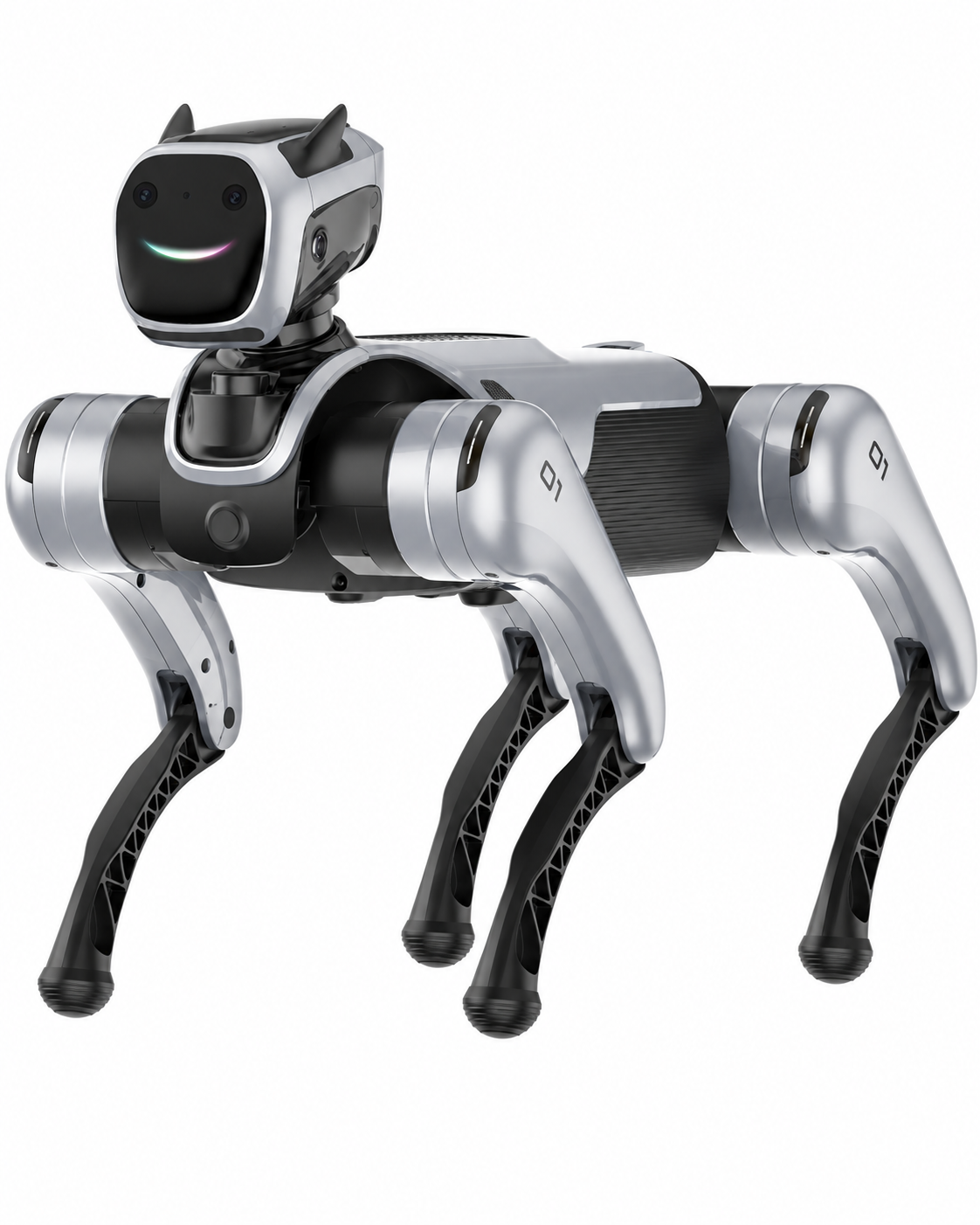
Manufacturer's own photo.
Intended use, per the manufacturer
The manufacturer’s words
MagicDog is an intelligent quadruped robot developed for research, education, interactive entertainment and companion-style applications.
Source: magiclabglobal.com · Retrieved
The same paragraph ends: "PRO and EDU configurations are available".
This category is not our assessment.
Every field in the schema
14 of 33 fields statedImperial figures are our own conversion unless the manufacturer states an imperial figure itself. The source letter always belongs to the metric figure — a conversion has no source of its own.
| Field | Value | Source and caveats |
|---|---|---|
| Physical | ||
| Weight | 15.8kg34.8lbOur conversion from 15.8 kg. The manufacturer does not state an imperial figure itself, so the conversion has no source of its own. | A CaveatEXCLUDING BATTERY (Net Weight, Excluding Battery) — unique in this collection; every other model, including MagicLab’s own MagicDog-W and Y1, states weight including battery. Without that marking, payload divided by net weight is systematically wrong, and wrong in the flattering direction. The global site states 17 kg including battery for the same robot; the two figures are consistent if the battery weighs about 1.2 kg, but that is an inference and is not entered as data. |
| Length | 67cm26.4inOur conversion from 67 cm. The manufacturer does not state an imperial figure itself, so the conversion has no source of its own. | A |
| Width | 35cm13.8inOur conversion from 35 cm. The manufacturer does not state an imperial figure itself, so the conversion has no source of its own. | A |
| Height | 56cm22inOur conversion from 56 cm. The manufacturer does not state an imperial figure itself, so the conversion has no source of its own. | A NoteLying down 720 x 440 x 290 mm. The table has no fields for folded dimensions. |
| Degrees of freedom | 13DoF | A CaveatThe manufacturer states Degrees of Freedom (DOF) 13 and, separately, Aluminum Alloy Precision Joint Motor 12. The global site states the same figure as 12 + 1 (head DOF) — i.e. 12 in the legs plus the head. |
| Payload, walking | approximately 5kgapproximately 11lbOur conversion from 5 kg. The manufacturer does not state an imperial figure itself, so the conversion has no source of its own. | A CaveatThe manufacturer states approx. 5 kg (max. approx. 10 kg) using the character U+2248 and full-width parentheses. No distinction is made between walking and standing load. |
| Payload, standing | not stated | |
| Max speed | 10.8km/h6.71mphOur conversion from 10.8 km/h. The manufacturer does not state an imperial figure itself, so the conversion has no source of its own. | A CaveatLabel Maximum Speed. The global site states the same figure as Movement Speed 0-3.0m/s, i.e. a range rather than a maximum. |
| Max slope | 40° | A |
| Single obstacle | 15cm5.91inOur conversion from 15 cm. The manufacturer does not state an imperial figure itself, so the conversion has no source of its own. | A CaveatLabel Maximum Obstacle Height. The global site states Max Obstacle Step Height Approx. 18cm (lab data) for the same robot — 20% higher, and with a lab-condition marking the older site does not carry. |
| Stair step, continuous | not stated | |
| IP rating | not stated | |
| Operating temperature, low | not stated | |
| Operating temperature, high | not stated | |
| Power | ||
| Battery | not stated | A NoteThe manufacturer prints 29.6V 8200mAh 240.7W Fast Release. W is POWER, not energy. The error appears in both languages — it is not a translation slip but the manufacturer’s own. Even read charitably as 240.7 Wh it does not add up: 29.6 V x 8.2 Ah = 242.7 Wh. We do not correct it, and we do not calculate Wh from mAh and voltage. |
| Runtime | 90–180minWarning: load condition not stated | A CaveatThe global site instead states Approx. 2.5 hours of continuous movement. |
| Hot-swap battery | not stated | |
| Charge time | not stated | |
| Docking station | yes | A NoteBattery Charging Dock marked with a filled circle. The table uses filled circle = yes and open circle = no, with NO third state for not stated. A scraper that only looks for the filled circle records a ‘no’ as a missing value. |
| Sensing and autonomy | ||
| LiDAR | not stated | A Note2D LiDAR — type without model, does not count under D4. |
| Cameras | dual camera + depth camera + 4K HD camera + fisheye camera + ultrasonic sensor | A |
| Onboard compute | 8-core CPU | A |
| ROS 2 | not stated | B NoteThe manufacturer’s own developer documentation for MagicDog HAS ROS2 (ROS2 API, ROS2 SDK guide, ros2_reference), and EDU is the variant with SDK access. The field is nonetheless left blank because D1 — whether the manufacturer’s developer documentation counts as a source — is open. If D1 is resolved, the field is filled in. The documentation is also Chinese-only, so a reader cannot read the source. |
| SDK languages | not stated | A NoteSDK Support is marked with a filled circle = YES on EDU and an open circle = no on PRO. That is the only specification difference between the two models, and the sign is counterintuitive: it is EDU that has the SDK. The field asks about the LANGUAGES, which the product page does not mention — hence not stated here, against PRO’s documented no. The developer documentation (D1 open) states C++ and Python. |
| Autonomy level | Smart Obstacle Avoidance; Patrol Mode; Smart Following | A NoteAll three marked yes. Qualitative, not a level on a scale. |
| Payload and expansion | ||
| Mounting interface | not stated | |
| Power out | not stated | |
| Data ports | not stated | |
| Commercial | ||
| Indicative price | not stated | |
| EU | ||
| CE stated | not stated | Records only what the manufacturer states regarding CE marking. |
| FCC stated | not stated | |
| UL stated | not stated | |
| CCC stated | not stated | |
Stair step and payload each exist in two variants. Only compare fields with the same label.
Notes
- The manufacturer's own site states it is headquartered in Suzhou, China — not Wujiang, a city sometimes attributed to it.
- The manufacturer runs two official sites that disagree on weight, obstacle height, degrees of freedom, runtime, and speed. Figures here follow the manufacturer's main site.
The manufacturer’s own page
The manufacturer’s original product page for this model.
Open the manufacturer’s page for MagicDog EDUhttps://www.magiclab.top/en/dog
Sources
- A Manufacturer product page. www.magiclab.top/en/dog · Retrieved
- B support.magiclab.top/docs/dog/about · Retrieved
- C www.magiclabglobal.com/products/magicdog/ · Retrieved
One line per source, not per figure: a source has one retrieval date. The letter beside a figure points to the line it came from.