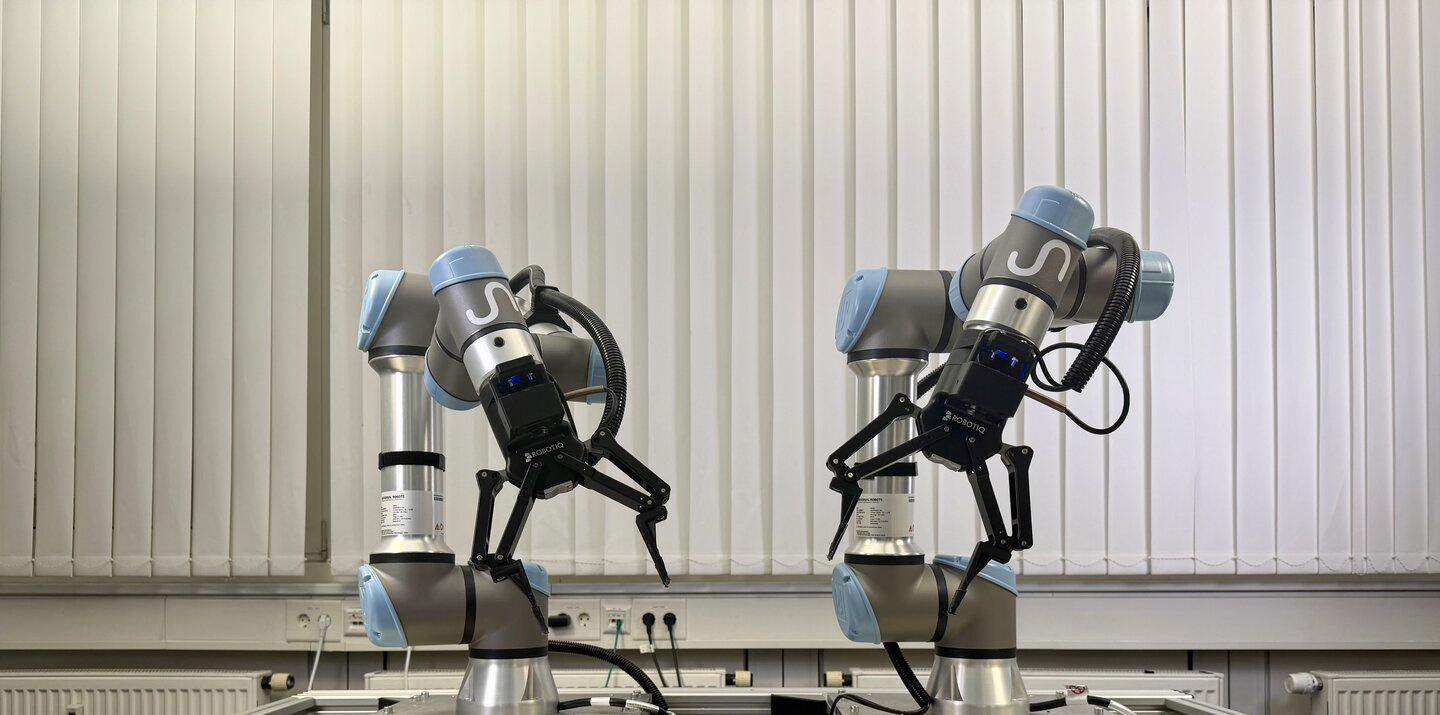
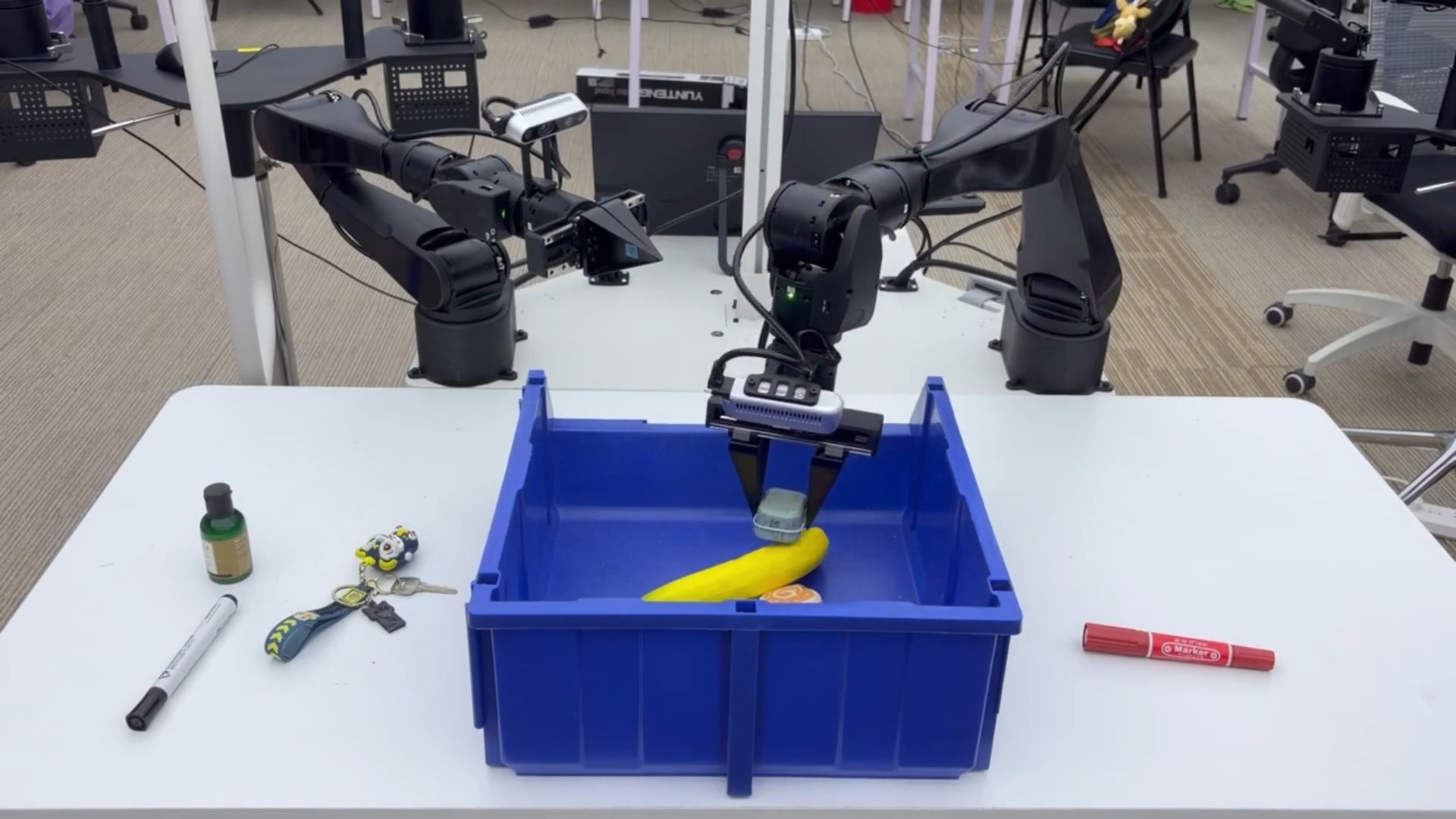
Inria · robot AI model
Hi3R-VLA
France · 2026
Sources retrieved: (A, B, C)
- Model type
- Vision-language-action (VLA)Source and note: Model typeB arxiv.org/abs/2611.31535 · Retrieved Note. Developer wording: “We introduce Hi3R-VLA, a 3D policy that grounds heterogeneous modalities - vision, language, and action - in explicit 3D geometry for robotic manipulation.”
- What it controls
- Arms and handsSource and note: What it controlsB arxiv.org/abs/2611.31535 · Retrieved Note. Abstract: the model “anchors low-level control commands in the same 3D coordinate frame”, “across diverse manipulation tasks and embodiments, from single-arm and dual-arm grippers to dexterous hands”.
- Inputs
- Camera Depth Robot state LanguageSource and note: InputsA arxiv.org/html/2611.31535 · Retrieved Note. Abstract: “Our model integrates spatially-aligned visual features and language conditioning into point cloud representations”. Paper: the model is conditioned on the observations, “including the point cloud, images, robot state, and language instruction”; the point cloud is built “from calibrated RGB-D cameras”.
- Access
- Open weights (download)Source and note: AccessC huggingface.co/api/models/cshizhe/hi3r_vla · Retrieved Note. The public Hugging Face repository cshizhe/hi3r_vla is not gated and lists weight files such as “dexjoco/model.safetensors”.
Specifications
7 of 14 stated 7 not stated
5 fields hidden 2 not-stated fields with a note stay ·
How to read the figuresShow guideClose
- not statedNo source
- 0Reported as zero
- ASource
Select a source marker for source details and notes.
Release1/1 disclosed
Released23 November 2026
Source and note: ReleasedB arxiv.org/abs/2611.31535 · Retrieved Note. arXiv listing: “Submitted on 23 Nov 2026”.
Input and output3/4 disclosed
Model typeVision-language-action (VLA)
Source and note: Model typeB arxiv.org/abs/2611.31535 · Retrieved Note. Developer wording: “We introduce Hi3R-VLA, a 3D policy that grounds heterogeneous modalities - vision, language, and action - in explicit 3D geometry for robotic manipulation.”
InputsCamera Depth Robot state Language
Source and note: InputsA arxiv.org/html/2611.31535 · Retrieved Note. Abstract: “Our model integrates spatially-aligned visual features and language conditioning into point cloud representations”. Paper: the model is conditioned on the observations, “including the point cloud, images, robot state, and language instruction”; the point cloud is built “from calibrated RGB-D cameras”.
What it controlsArms and hands
Source and note: What it controlsB arxiv.org/abs/2611.31535 · Retrieved Note. Abstract: the model “anchors low-level control commands in the same 3D coordinate frame”, “across diverse manipulation tasks and embodiments, from single-arm and dual-arm grippers to dexterous hands”.
Degrees of freedom controlledNot stated
Size and speed1/2 disclosed
ParametersNot stated
Source and note: ParametersA arxiv.org/html/2611.31535 · Retrieved Note. Paper: “The SigLIP2” image and text encoders remain frozen except for their final projection layers, “resulting in fewer than 250M trainable parameters overall.”
Control rate15Hz
Source and note: Control rateA arxiv.org/html/2611.31535 · Retrieved Note. Action loop of the developer's real-robot setup, “We use a 6-DoF UR5 robotic arm”: “The action loop runs at 15 Hz.”
Where it runs and what it is built on0/2 disclosed
On robot or cloudNot stated
Base modelNot stated
Openness1/3 disclosed
AccessOpen weights (download)
Source and note: AccessC huggingface.co/api/models/cshizhe/hi3r_vla · Retrieved Note. The public Hugging Face repository cshizhe/hi3r_vla is not gated and lists weight files such as “dexjoco/model.safetensors”.
Licence documentNot stated
Licence typeNot stated
The developer’s own claims1/2 disclosed
Learns new tasksNeeds retraining
Source and note: Learns new tasksA arxiv.org/html/2611.31535 · Retrieved Note. Paper: “Hi3R-VLA is first pretrained on DROID and then fine-tuned on each benchmark.”
Works across robotsNot stated
Source and note: Works across robotsYes only if the developer itself says the model runs on different robot models, for example robots from two manufacturers or two of one manufacturer’s models. Several units of the same robot do not count.
Notes
The project page credits “Inria, École normale supérieure, CNRS, PSL Research University”.
The project page still shows “Code (coming soon)”, while the arXiv paper states: “The model, code and dataset are publicly released.”
Sources
One line per source, not per figure: a source has one retrieval date.
- Aarxiv.org/html/2611.31535Retrieved
- Barxiv.org/abs/2611.31535Main source. Retrieved
- Chuggingface.co/api/models/cshizhe/hi3r_vlaRetrieved