Rhoda AI · robot AI model
DVA
United States · 2026
Sources retrieved: 2 November 2026 (A, B, C)
- What it controls
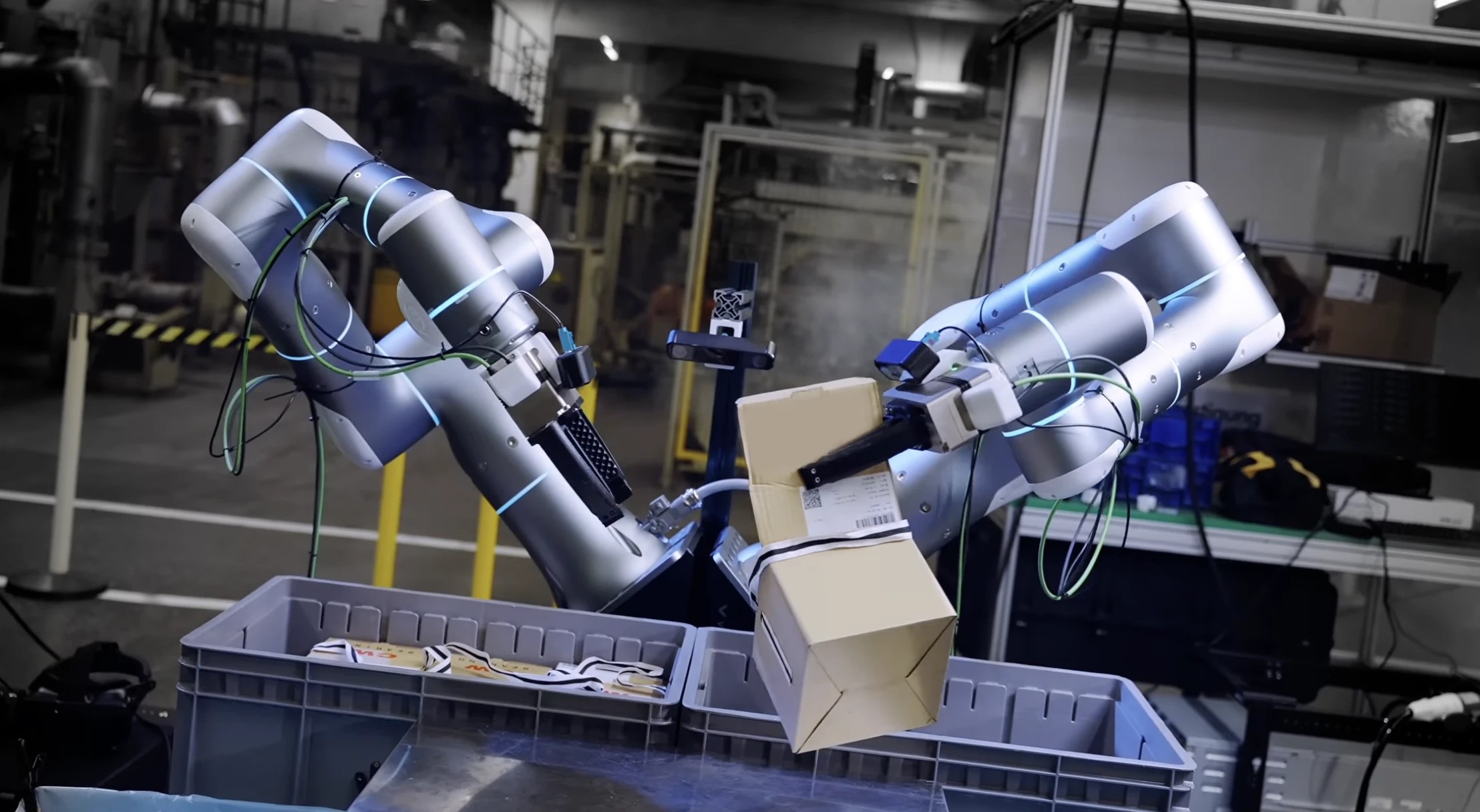
- Arms and handsSource and note: What it controlsB rhoda.ai/research/scaling-web-video-pretraining · Retrieved 2 November 2026Note. Rhoda evaluates DVA on manipulation: “benchmark on a real industrial manipulation task”.
- Inputs
- Camera Language Robot state TouchSource and note: InputsA rhoda.ai/research/direct-video-action · Retrieved 2 November 2026Note. “Conditioned on a long context of captured video from the robot, proprioception, and other conditioning signals (e.g. language), we predict a short period into the future, visually.” Touch is part of the multimodal version of 13 October 2026: Rhoda developed a tactile sensor and “integrated its measurements into a multimodal Direct Video-Action (DVA) model”.
- Base model
- None (trained from scratch)Source and note: Base modelA rhoda.ai/research/direct-video-action · Retrieved 2 November 2026Note. Rhoda's wording: “We pre-train from scratch as a causal video model, rather than distilling from a pre-trained bi-directional model.”
Specifications
5/14 specifications disclosed 9 not stated
4 fields hidden 5 not-stated fields with a note stay ·
How to read the figuresShow guideClose
Not statedThe developer publishes nothing on itNoThe developer says it does not
Select a source marker for source details and notes.
Release1/1 disclosed
Released10 March 2026
Source and note: ReleasedC rhoda.ai/news/press-release · Retrieved 2 November 2026Note. [A] Press release dated March 10, 2026: “Rhoda AI today announced its public launch after 18 months in stealth”.
Input and output2/4 disclosed
Model typeNot stated
Source and note: Model typeA rhoda.ai/research/direct-video-action · Retrieved 2 November 2026Note. Rhoda's own term: “A robot policy that translates predictions from a pre-trained causal video model into actions in a real-time closed loop, with the video model directly responsible for decision-making.”
InputsCamera Language Robot state Touch
Source and note: InputsA rhoda.ai/research/direct-video-action · Retrieved 2 November 2026Note. “Conditioned on a long context of captured video from the robot, proprioception, and other conditioning signals (e.g. language), we predict a short period into the future, visually.” Touch is part of the multimodal version of 13 October 2026: Rhoda developed a tactile sensor and “integrated its measurements into a multimodal Direct Video-Action (DVA) model”.
What it controlsArms and hands
Source and note: What it controlsB rhoda.ai/research/scaling-web-video-pretraining · Retrieved 2 November 2026Note. Rhoda evaluates DVA on manipulation: “benchmark on a real industrial manipulation task”.
Degrees of freedom controlledNot stated
Size and speed0/2 disclosed
ParametersNot stated
Control rateNot stated
Source and note: Control rateC rhoda.ai/news/press-release · Retrieved 2 November 2026Note. The press release gives an interval, not a rate: “repeating this process every few hundred milliseconds in a closed loop”.
Where it runs and what it is built on1/2 disclosed
On robot or cloudNot stated
Base modelNone (trained from scratch)
Source and note: Base modelA rhoda.ai/research/direct-video-action · Retrieved 2 November 2026Note. Rhoda's wording: “We pre-train from scratch as a causal video model, rather than distilling from a pre-trained bi-directional model.”
Openness0/3 disclosed
AccessNot stated
Source and note: AccessC rhoda.ai/news/press-release · Retrieved 2 November 2026Note. Rhoda's press release: “a foundation model that powers Rhoda systems today and is expected over time to be licensed to partners across different robotic hardware and software platforms”.
Licence documentNot stated
Source and note: Licence documentC rhoda.ai/news/press-release · Retrieved 2 November 2026Note. Rhoda's press release: “Rhoda calls this proprietary architecture a Direct Video Action (DVA) model”.
Licence typeNot stated
The developer’s own claims1/2 disclosed
Learns new tasksFrom a few examples
Source and note: Learns new tasksA rhoda.ai/research/direct-video-action · Retrieved 2 November 2026Note. Developer claim: DVA has “learning to imitate human behavior from a single demonstration, in-context, at test time”. New robots and tasks are also taught by post-training: “post-trains the models on smaller amounts of robot data to learn embodiment-specific behaviors”.
Works across robotsNot stated
Source and note: Works across robotsA rhoda.ai/research/direct-video-action · Retrieved 2 November 2026Note. Rhoda states a limit: “Once trained, the inverse dynamics model can be used across different robots of the same type and across many tasks.”Yes only if the developer itself says the model runs on different robot models, for example robots from two manufacturers or two of one manufacturer’s models. Several units of the same robot do not count.
Notes
Rhoda AI introduced the Direct Video-Action Model with its public launch on 10 March 2026.
DVA is the architecture behind Rhoda's FutureVision foundation model.
Sources
One line per source, not per figure: a source has one retrieval date.
- Arhoda.ai/research/direct-video-actionMain source. Retrieved 2 November 2026
- Brhoda.ai/research/scaling-web-video-pretrainingRetrieved 2 November 2026
- Crhoda.ai/news/press-releaseRetrieved 2 November 2026