Unitree RoboticsChina2025
R1
- In production
- 20–40 kg44–88 lb
- not stated
VariantsR1 AIRR1 EDU
The manufacturer sells this model in several variants. The figures on this page apply to the variant the source names.
Key figures as stated by the manufacturer
3 of 6 stated · 3 gaps- Weight A approximately 29kgapproximately 63.9lbOur conversion from 29 kg. The manufacturer does not state an imperial figure itself, so the conversion has no source of its own.
- Payload, walking not stated
- Runtime A approximately 60minWarning: load condition not stated
- Max speed not stated
- AI model not stated
- Indicative price A 5,900USD
How to read the figures
- 14kgA30.9lbA
- The letter in the grey square after a figure points to the source the figure came from. Robots with several sources carry several letters.
- Payload, walking
- A stroke before a field name means the figure carries a caveat that affects how it compares with other robots. The caveat is printed with the figure.
- 74.5lb
- Imperial figures are our own conversion unless the manufacturer states an imperial figure itself. The source letter always belongs to the metric figure — a conversion has no source of its own.
Deviations and variants in the key figures (4)
Weight
Note "Weight (With Battery): About 29kg" (R1 column; R1 AIR is about 27kg).
Payload, walking
Note Only an arm-specific load ("About 2kg", mislabeled "Maximum Torque of Arm Joint") is given, not a figure for what the whole robot can carry - see this robot's notes above.
Runtime
Caveat "Battery Life: About 1h" (all three tiers); the producer gives no task or load condition for this figure.
Indicative price
Caveat "R1: $5,900" (tax and shipping cost excluded). R1 AIR is $4,900 and R1 EDU has no listed price ("Contact Sales").
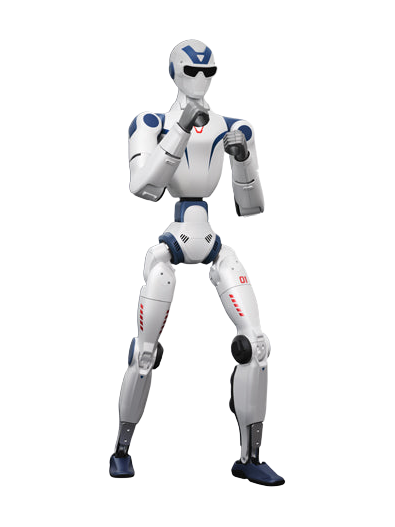
Manufacturer's own photo.
The manufacturer states that the image shows the prototype and that the final appearance may differ.
Intended use, per the manufacturer
Source: unitree.com · Retrieved
The page markets R1 on "movement first, tasks as well" and open control/simulation interfaces for developers, without naming a specific industry or usage sector for the robot.
This category is not our assessment.
Full specifications
11 of 33 fields stated| Field | Value | Source and caveats |
|---|---|---|
| Physical | ||
| Weight | approximately 29kgapproximately 63.9lbOur conversion from 29 kg. The manufacturer does not state an imperial figure itself, so the conversion has no source of its own. | Note "Weight (With Battery): About 29kg" (R1 column; R1 AIR is about 27kg). A |
| Length | 19cm7.48inOur conversion from 19 cm. The manufacturer does not state an imperial figure itself, so the conversion has no source of its own. | Caveat Third value of "Height, Width and Thickness (Stand): 1230x357x190mm" (same for all three tiers). A |
| Width | 35.7cm14.1inOur conversion from 35.7 cm. The manufacturer does not state an imperial figure itself, so the conversion has no source of its own. | Note Second value of the same labeled triplet. A |
| Height | 123cm48.4inOur conversion from 123 cm. The manufacturer does not state an imperial figure itself, so the conversion has no source of its own. | Note First value of the same labeled triplet; matches the hero copy's "≤123cm agile form". A |
| Degrees of freedom | 26DoF | Note "Degree of Freedom (Total Joints): 26" (R1 column), consistent with the page's own breakdown: single leg 6, single arm 5, waist 2, head 2 (6x2 + 5x2 + 2 + 2 = 26). A |
| Payload, walking | not stated | Note Only an arm-specific load ("About 2kg", mislabeled "Maximum Torque of Arm Joint") is given, not a figure for what the whole robot can carry - see this robot's notes above. A |
| Payload, standing | not stated | Note Same as the walking-payload figure above. A |
| Max speed | not stated | |
| Max slope | not stated | |
| Single obstacle | not stated | |
| Stair step, continuous | not stated | |
| IP rating | not stated | |
| Operating temperature, low | not stated | |
| Operating temperature, high | not stated | |
| Power | ||
| Battery | not stated | Note Only "Lithium battery" is named as the power supply; no Ah/Wh figure is given. A |
| Runtime | approximately 60minWarning: load condition not stated | Caveat "Battery Life: About 1h" (all three tiers); the producer gives no task or load condition for this figure. A |
| Hot-swap battery | not stated | Note Accessory named "Smart Battery (Quick Release)" - the page does not confirm whether the robot stays powered during replacement, which true hot-swapping would require. A |
| Charge time | not stated | Note A charger is listed as an included accessory, but no time-to-full-charge figure is stated. A |
| Docking station | no | Note The page's full accessories list (High-Power Computing Module, Smart Battery, Charger, Manual Controller) does not include a docking/self-charging station. A |
| Sensing and autonomy | ||
| LiDAR | not stated | Note No lidar is stated as part of R1 itself; only a monocular/binocular camera is given as a sensor. A "4D LiDAR" link elsewhere on the page is to a separate, standalone Unitree product. A |
| Cameras | Binocular camera. | Note R1 and R1 EDU both state "Binocular camera"; R1 AIR instead states "Monocular camera". A |
| Onboard compute | 8-core high-performance processor. | Note Base "Basic Computing Power" row, stated identically for all three tiers. R1 EDU additionally offers an optional "High-Power Computing Module" (e.g. Orin, 40-100 TOPS) - not included here as it is not part of the base R1 configuration. A |
| ROS 2 | no | Caveat Shop page, verbatim: "Only the EDU version supports secondary development." Consistent with the product page's own comparison table, which reads "/" for R1 (and R1 AIR) versus "YES" for R1 EDU under "Secondary Development". B |
| SDK languages | no | Caveat Written as "no" rather than an empty list of languages. Shop page, verbatim: "Only the EDU version supports secondary development." Consistent with the product page's own comparison table, which reads "/" for R1 (and R1 AIR) versus "YES" for R1 EDU under "Secondary Development". B |
| Autonomy level | not stated | Note The page describes integration with a large multimodal model for voice and images, and fully open control interfaces for joints and sensors with support for mainstream simulation platforms - but this is a capability description, not a named operational autonomy level. A |
| Payload and expansion | ||
| Mounting interface | not stated | |
| Power out | not stated | |
| Data ports | not stated | |
| Commercial | ||
| Indicative price | 5,900USD | Caveat "R1: $5,900" (tax and shipping cost excluded). R1 AIR is $4,900 and R1 EDU has no listed price ("Contact Sales"). A Price shown in USD, converted using the European Central Bank reference rate for 31/08/2026. C |
| EU | ||
| CE stated | not stated | Records only what the manufacturer states regarding CE marking. |
| FCC stated | not stated | |
| UL stated | not stated | |
| CCC stated | not stated | |
Notes
- Unitree sells three tiers side by side on this page: "R1 AIR" ($4,900), "R1" ($5,900) and "R1 EDU" (contact sales). The figures are for the middle "R1" tier.
- Secondary-development/SDK support reads "/" for both R1 AIR and R1, versus "YES" for R1 EDU, the same dash-versus-"YES" marking Unitree uses on its H2 product page.
- A row labeled "Maximum Torque of Arm Joint" gives a value in kg ("About 2kg"), not N·m, with a footnote that "the maximum load of the arm varies greatly under different arm extension postures". The row is read here as an arm load figure, not a joint torque, and not a figure for what the whole robot can carry.
- Camera is "Binocular camera" for R1 and R1 EDU, versus "Monocular camera" for R1 AIR.
- Interesting Engineering reported on 25 July 2025 that Unitree had unveiled the R1 humanoid robot at 39,999 yuan.
The manufacturer’s own page
The manufacturer’s original product page for this model.
Open the manufacturer’s page for R1https://www.unitree.com/R1
Sources
-
A
Manufacturer product page. www.
unitree. · Retrievedcom/ R1 -
B
shop.
unitree. · Retrievedcom/ products/ unitree-r1 -
C
Rate: European Central Bank, Euro foreign exchange reference rates, 31/08/2026. www.
ecb. · Retrievedeuropa. eu/ stats/ eurofxref/ eurofxref-daily. xml
One line per source, not per figure: a source has one retrieval date. The letter beside a figure points to the line it came from.