MagicLabChina2025
MagicBot Z1
- 20–40 kg44–88 lb
- Research and development
- Consumer and education
- Entertainment
Key figures as stated by the manufacturer
1 of 6 stated · 5 gaps- Weight A approximately 40kgapproximately 88.2lbOur conversion from 40 kg. The manufacturer does not state an imperial figure itself, so the conversion has no source of its own.
- Payload, walking not stated
- Runtime not stated
- Max speed not stated
- AI model not stated
- Indicative price not stated
How to read the figures
- 14kgA30.9lbA
- The letter in the grey square after a figure points to the source the figure came from. Robots with several sources carry several letters.
- Payload, walking
- A stroke before a field name means the figure carries a caveat that affects how it compares with other robots. The caveat is printed with the figure.
- 74.5lb
- Imperial figures are our own conversion unless the manufacturer states an imperial figure itself. The source letter always belongs to the metric figure — a conversion has no source of its own.
Deviations and variants in the key figures (3)
Weight
Note Weight with battery. The producer writes "40 kg+" and does not explain the plus sign.
Payload, walking
Note The table gives "Maximum Single-Arm Payload" as 3 kg. That is an arm-specific figure, not a figure for what the whole robot can carry.
Max speed
Note The Z1 column gives no speed figure; it says the robot "Supports humanoid walking, humanoid running, and getting up after falling".
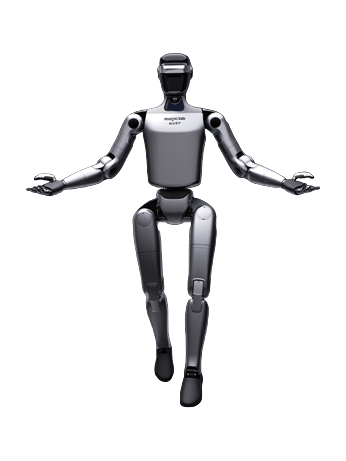
Manufacturer's own photo.
Intended use, per the manufacturer
The manufacturer’s words
scientific research and education, exhibitions and exchanges, commercial performances and entertainment, and home companionship
Source: magiclabglobal.com · Retrieved
This category is not our assessment.
Full specifications
8 of 33 fields stated| Field | Value | Source and caveats |
|---|---|---|
| Physical | ||
| Weight | approximately 40kgapproximately 88.2lbOur conversion from 40 kg. The manufacturer does not state an imperial figure itself, so the conversion has no source of its own. | Note Weight with battery. The producer writes "40 kg+" and does not explain the plus sign. A |
| Length | 20cm7.87inOur conversion from 20 cm. The manufacturer does not state an imperial figure itself, so the conversion has no source of its own. | Note Third value (thickness) of the "Standing Height × Width × Thickness" row. A |
| Width | 42.2cm16.6inOur conversion from 42.2 cm. The manufacturer does not state an imperial figure itself, so the conversion has no source of its own. | Note Second value of the "Standing Height × Width × Thickness" row. A |
| Height | 136.9cm53.9inOur conversion from 136.9 cm. The manufacturer does not state an imperial figure itself, so the conversion has no source of its own. | Note First value of the "Standing Height × Width × Thickness" row. A |
| Degrees of freedom | 24DoF | Note Basic configuration: head 1, waist 1, leg 6 per leg, arm 5 per arm. The table lists 2 wrist DoF and an 11-DoF dexterous hand as optional additions and says the total can be expanded up to 50 DoF. A |
| Payload, walking | not stated | Note The table gives "Maximum Single-Arm Payload" as 3 kg. That is an arm-specific figure, not a figure for what the whole robot can carry. A |
| Payload, standing | not stated | Note The table gives "Maximum Single-Arm Payload" as 3 kg. That is an arm-specific figure, not a figure for what the whole robot can carry. A |
| Max speed | not stated | Note The Z1 column gives no speed figure; it says the robot "Supports humanoid walking, humanoid running, and getting up after falling". A |
| Max slope | not stated | |
| Single obstacle | not stated | |
| Stair step, continuous | not stated | |
| IP rating | not stated | |
| Operating temperature, low | not stated | |
| Operating temperature, high | not stated | |
| Power | ||
| Battery | not stated | Note The Z1 column gives a capacity of 10000 mAh and no voltage. A |
| Runtime | not stated | |
| Hot-swap battery | not stated | Caveat The page describes a quick-release smart battery; it does not say the robot stays powered during a swap. A |
| Charge time | not stated | |
| Docking station | not stated | |
| Sensing and autonomy | ||
| LiDAR | 3D LiDAR. | Note Sensor Configuration row of the Z1 column. A |
| Cameras | Depth camera and binocular fisheye camera. | Note Sensor Configuration row of the Z1 column. A |
| Onboard compute | 8-core high-performance CPU as the basic configuration; a higher-computing-power module is optional. | Note Computing Module row of the Z1 column. A |
| ROS 2 | not stated | |
| SDK languages | not stated | Note The table says "Supports OTA / secondary development" and names no programming languages. A |
| Autonomy level | not stated | |
| Payload and expansion | ||
| Mounting interface | not stated | Note The table lists an optional 11-DoF dexterous hand but names no mounting interface. A |
| Power out | not stated | |
| Data ports | not stated | |
| Commercial | ||
| Indicative price | not stated | |
| EU | ||
| CE stated | not stated | Records only what the manufacturer states regarding CE marking. |
| FCC stated | not stated | |
| UL stated | not stated | |
| CCC stated | not stated | |
Notes
- The page has a "Get a Quote" button and no price.
- IT Home reported on 8 July 2025 that MagicLab released the high-dynamic bipedal humanoid MagicBot Z1 that day (translated from the Chinese).
The manufacturer’s own page
The manufacturer’s original product page for this model.
Open the manufacturer’s page for MagicBot Z1https://www.magiclabglobal.com/products/magicbot-z1/
Sources
-
A
Manufacturer product page. www.
magiclabglobal. · Retrievedcom/ products/ magicbot-z1/
One line per source, not per figure: a source has one retrieval date. The letter beside a figure points to the line it came from.