Key figures as stated by the manufacturer
2 of 6 stated · 4 gaps- Weight A 70kg154lbOur conversion from 70 kg. The manufacturer does not state an imperial figure itself, so the conversion has no source of its own.
- Payload, walking not stated
- Runtime A approximately 180minWarning: load condition not stated
- Max speed not stated
- AI model not stated
- Indicative price not stated
How to read the figures
- 1,100mmB43.3inB
- A dashed letter marks a secondary source – a datasheet, manual or developer documentation from the manufacturer, or a press report used only where the manufacturer gives no figure.
- Payload, walking
- A stroke before a field name means the figure carries a caveat that affects how it compares with other robots. The caveat is printed with the figure.
- 74.5lb
- Imperial figures are our own conversion unless the manufacturer states an imperial figure itself. The source letter always belongs to the metric figure — a conversion has no source of its own.
Deviations and variants in the key figures (2)
Weight
Note Launch coverage, given with the height and a head-to-body ratio of 1:8.5.
Runtime
Caveat About 3 hours of dual-arm operation tasks; no load is given.
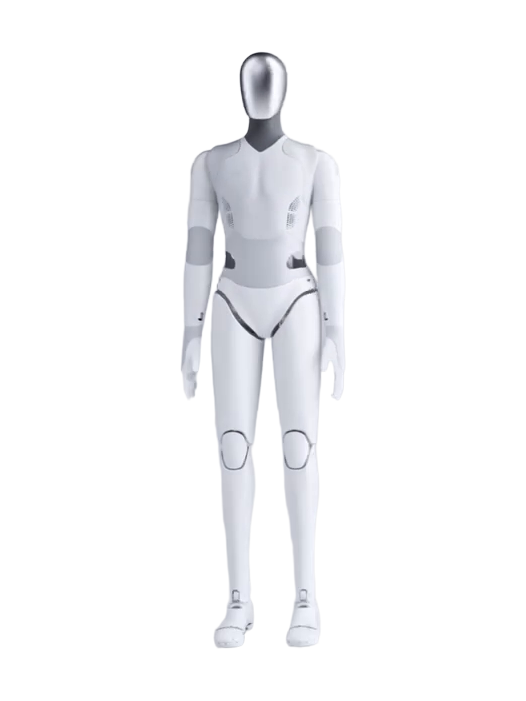
Manufacturer's own photo.
Still frame from the manufacturer's video.
Intended use, per the manufacturer
Source: kinetixai.tech · Retrieved
This category is not our assessment.
Full specifications
5 of 33 fields stated| Field | Value | Source and caveats |
|---|---|---|
| Physical | ||
| Weight | 70kg154lbOur conversion from 70 kg. The manufacturer does not state an imperial figure itself, so the conversion has no source of its own. | Note Launch coverage, given with the height and a head-to-body ratio of 1:8.5. A |
| Length | not stated | |
| Width | not stated | |
| Height | 173cm68.1inOur conversion from 173 cm. The manufacturer does not state an imperial figure itself, so the conversion has no source of its own. | Note Launch coverage, given with the weight and a head-to-body ratio of 1:8.5. A |
| Degrees of freedom | at most 117DoF | Caveat Up to 117 whole-body degrees of freedom in the August 2026 coverage; the April 2026 launch coverage gave 115. B |
| Payload, walking | not stated | |
| Payload, standing | not stated | Caveat The coverage gives a load close to 20 kg for the two arms together. That is an arm-specific figure, not a figure for what the whole robot can carry. A |
| Max speed | not stated | |
| Max slope | not stated | |
| Single obstacle | not stated | |
| Stair step, continuous | not stated | |
| IP rating | not stated | |
| Operating temperature, low | not stated | |
| Operating temperature, high | not stated | |
| Power | ||
| Battery | 1.7kWh | Note Semi-solid-state battery as given in the launch coverage. A |
| Runtime | approximately 180minWarning: load condition not stated | Caveat About 3 hours of dual-arm operation tasks; no load is given. A |
| Hot-swap battery | not stated | |
| Charge time | not stated | |
| Docking station | not stated | |
| Sensing and autonomy | ||
| LiDAR | not stated | |
| Cameras | not stated | |
| Onboard compute | not stated | |
| ROS 2 | not stated | |
| SDK languages | not stated | |
| Autonomy level | not stated | |
| Payload and expansion | ||
| Mounting interface | not stated | |
| Power out | not stated | |
| Data ports | not stated | |
| Commercial | ||
| Indicative price | not stated | |
| EU | ||
| CE stated | not stated | Records only what the manufacturer states regarding CE marking. |
| FCC stated | not stated | |
| UL stated | not stated | |
| CCC stated | not stated | |
Notes
- The specifications come from Chinese press coverage of the producer's launch event and of a robot conference in August 2026; the producer's own KaiBot page carries a video only.
- The launch coverage gives each hand 36 degrees of freedom, 22 actively controlled and 14 compliant (translated from the Chinese).
- The launch coverage describes a whole-body tactile skin with 18,000 contact points (translated from the Chinese).
- The producer presented KAI, its first full-size humanoid robot, at a launch event on 26 April 2026 (translated from the Chinese).
- The August 2026 coverage says the robot walks by itself to the interaction area to talk with visitors (translated from the Chinese).
- The August 2026 coverage gives more than 3 hours of normal work and 2 hours of slow walking (translated from the Chinese).
The manufacturer’s own page
The manufacturer’s original product page for this model.
Open the manufacturer’s page for KaiBothttps://www.kinetixai.tech/en
Sources
-
A
Secondary: www.
stdaily. · Retrievedcom/ web/ gdxw/ 2026-05/ 03/ content_ 511543. html -
B
Secondary: www.
news. · Retrievedcn/ finance/ 20260820/ 6b11dad688da 4404b87a2d16 9251d9b8/ c. html -
C
Manufacturer product page. www.
kinetixai. · Retrievedtech/ en
One line per source, not per figure: a source has one retrieval date. The letter beside a figure points to the line it came from.